Permanently expand your vocabulary — through crossword puzzles generated for you.
Lexi runs real spaced repetition underneath dynamically generated crosswords. Reviews are fill-in-the-blank sentences, not card flips. Grading is inferred from your solve speed. Every new word is introduced with an illustrated card before you're asked to recall it. And everything you've learned hangs overhead as a sky of stars.
Download free on the App Store
iPhone & iPad · free · no ads · no account required
This is an introduction in Lexi
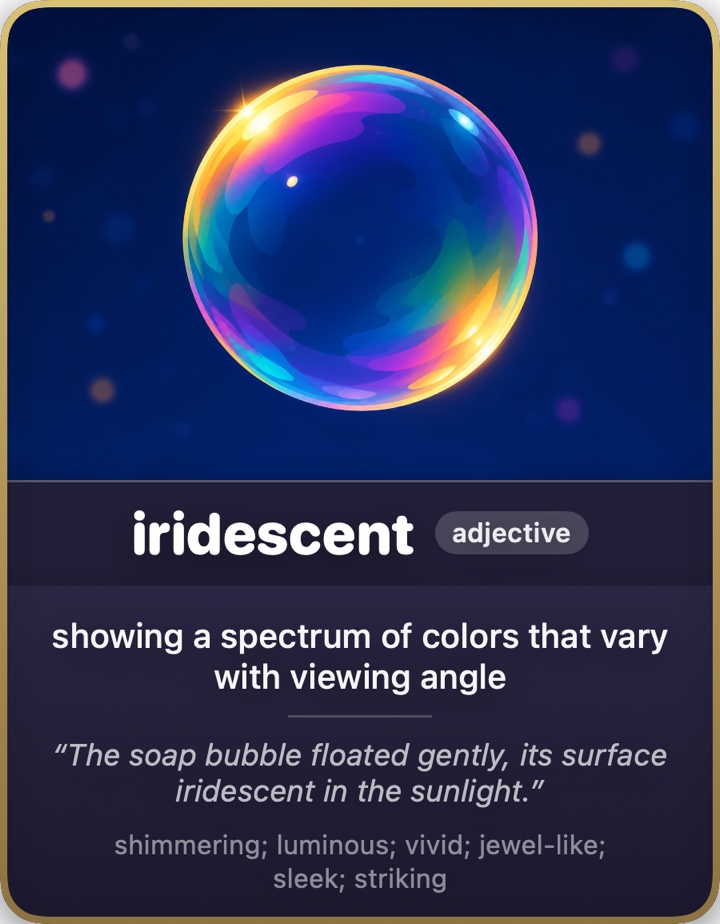
The first time you meet a word, you aren't quizzed on it — you're dealt its card: art built to evoke the meaning, the definition, an example that matches the picture. Iridescent arrives as a soap bubble catching the light, not a vocabulary item.
…and this is a review
![A Lexi clue exactly as it appears in-game: 'The coach's jab after the loss still [verb]d everyone in the locker room.' Hint: keep hurting inwardly; make someone bitter or annoyed.](/img/clue-rankle-1.jpg)
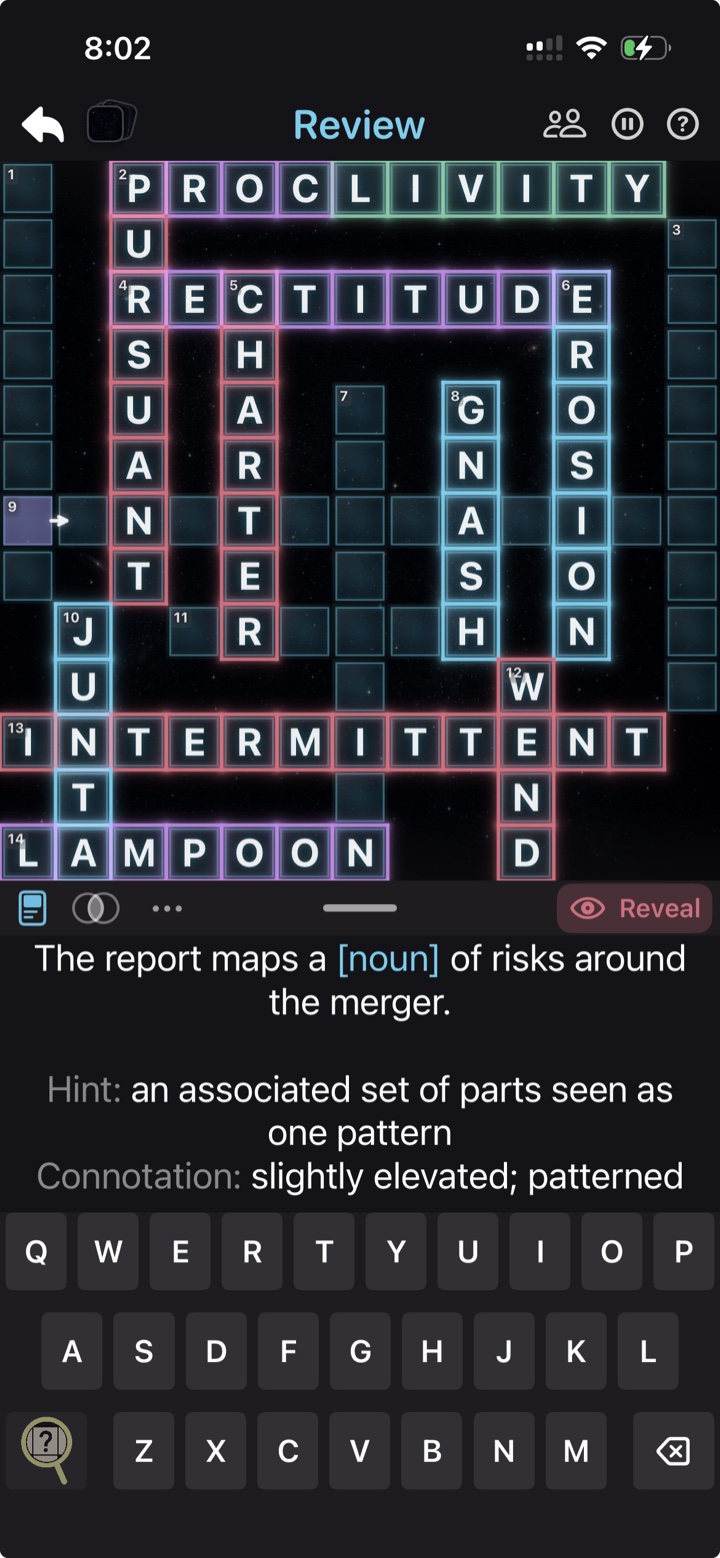
Days later, spaced repetition brings rankle back as a fill-in-the-blank sentence plus a hint — recall from a situation, the way you'll actually use it. Each word cycles through several differently-phrased clues on one schedule, so there's no phrasing to memorize; what sticks is the word.
Type it in, and the word pays off
Crossing letters scaffold what you half-know, and near-misses are caught as typos, not failures. Solve a review and the word's schedule stretches — here, three months — with its art flashing over the board.
Why not flashcards?
- Definition cards overfit. The prompt never changes, so you end up recognizing the definition's phrasing instead of commanding the word. Lexi varies the surface every repetition and keeps the schedule unified.
- Self-grading is decision fatigue. No Again/Hard/Good/Easy: your solve speed — normalized for clue and word length — raises or lowers each word's ease automatically.
- Cold first reps are brutal. Flashcards quiz you on words you've never seen. In Lexi, every first encounter starts with the word's illustrated card: image, definition, pictured example sentence, connotation tags.
- Clue quality can't be improvised. Each clue is produced by a creator → validator → guesser → reviser pipeline, up to seven revisions before acceptance — and keeps improving through in-app feedback.
Everything you've learned hangs overhead
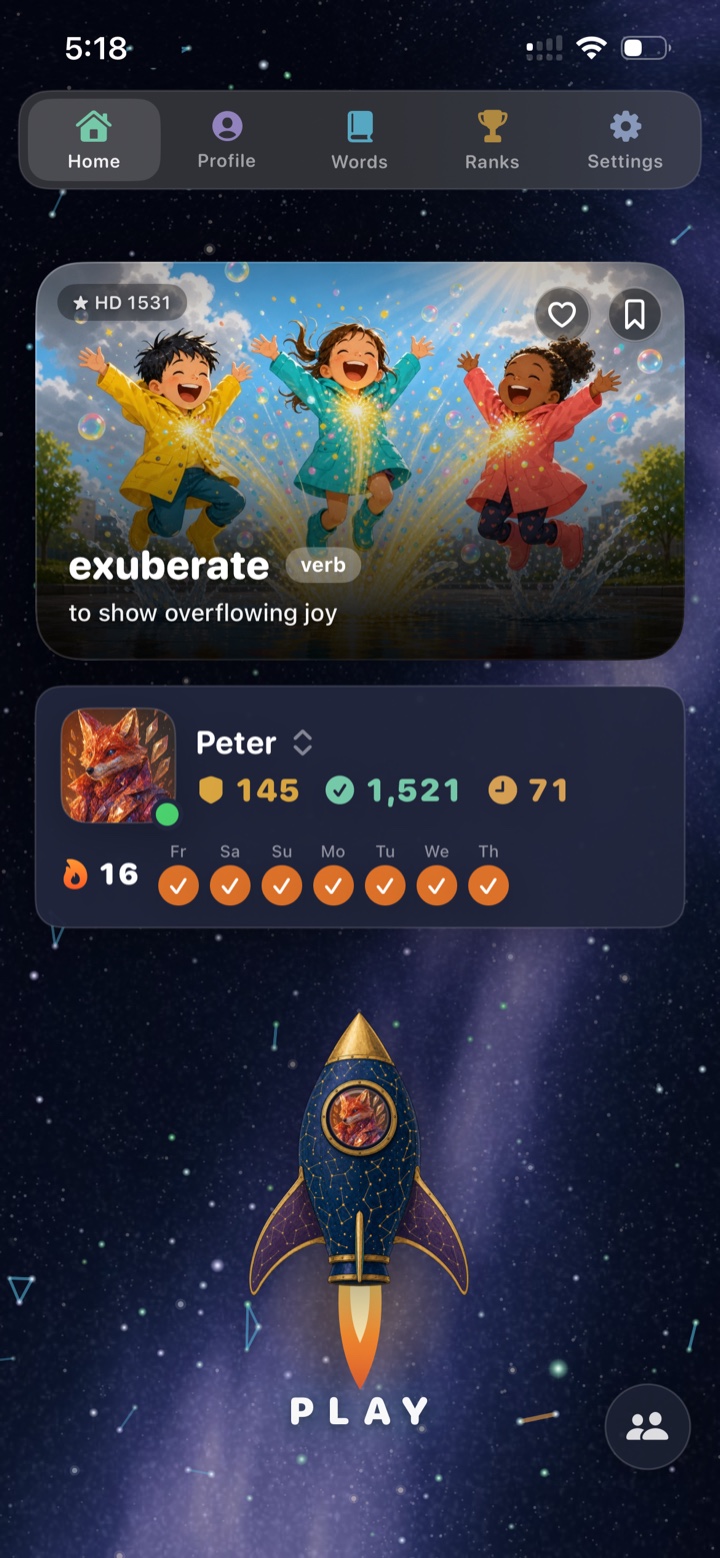
The home screen is a sky. Every learned word is a star, its color tracking the schedule — cool while safely known, warm as a review comes due. Words you've trained apart are drawn as constellations, and the rocket launches your next puzzle.
Confusable words get trained apart
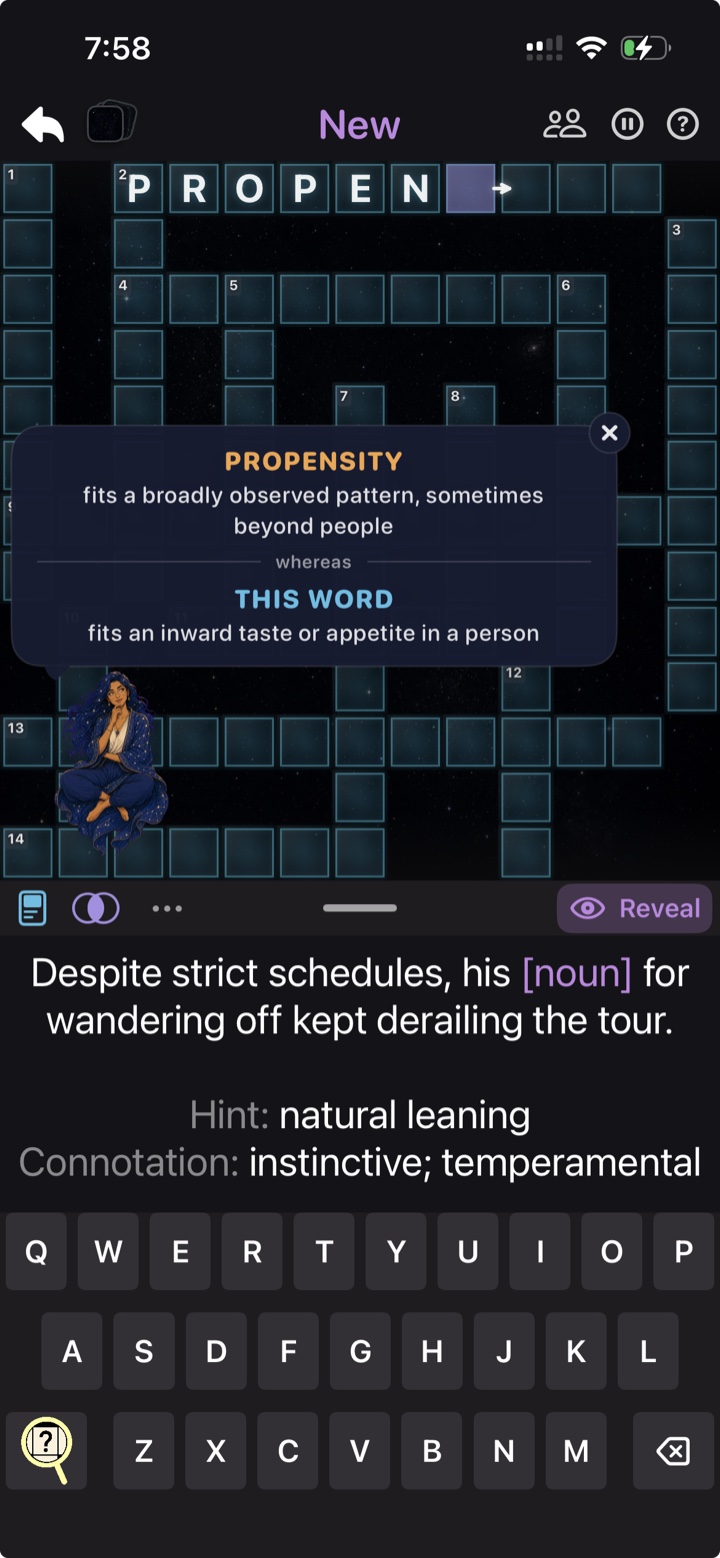
Knowing proclivity isn't much use if you can't say how it differs from propensity. Nuance cards state the difference precisely, match drills pit whole clusters — dale, glen, dell, dingle — against illustrated scenes, and typing a word's confusable cousin surfaces the distinction at the moment of the mix-up. Lexi Constella, keeper of your word-sky, teaches on the spot.
Contrastive training and the full companion wardrobe are Premium; the puzzles, the reviews, and your sky are free.
What's inside
- 20,000 words ordered roughly by rarity — maximal real-world utility per unit time spent
- Synonym nuance: tap any two synonyms to read precisely how they differ
- Collections that steer generation: save words, and puzzles prioritize words with related meanings
- Multiplayer, leaderboards, achievements, an activity heat map — and streaks you can rekindle after a slip, so one bad week doesn't erase months
- Companions you earn by learning: nine animals styled by adjectives from the word bank, each unlocked by answering its word
- The Observatory: a star log for every word, community posts, and study partners near your level
- Reminders fired from words actually due, not a fixed daily nag
- Profiles under one iCloud account — separate progress for you and your kid on the same iPad
Who it's for
People who want a bigger English vocabulary and a system that actually runs itself: readers and writers, GRE/SAT preppers, advanced ESL learners going from fluent to eloquent, and word-game players who want the time to count for something. English, on iPhone and iPad.